First Nations Climate Leadership in Action
In 2024, we launched a call for proposals as part of the Government of Québec 2030 Plan for a Green Economy to fund community-led initiatives that are rooted in local realities, priorities, and knowledge.
Our goal: to strengthen First Nations’ leadership on climate action. In total, we have distributed $5.3 million to First Nations to support 12 projects. These 12 initiatives demonstrate the strength, expertise, and resilience of First Nations in the face of climate change.
Taking Action on Climate Changes
We invite you to explore these initiatives and let yourself be inspired by the selected projects. These projects engage people of all ages, involve local stewards, pass down ancestral knowledge to young people, build their resilience, and demonstrate, in concrete terms, what Indigenous climate leadership can look like.

The Lobster-Seagrass System: a Cultural Value at the Heart of Essipit’S Resilience
For the Essipit community, lobster is more than an economic resource, it is a living connection to an ever-evolving territory.
As climate change warms the water, lobster has expanded its habitat and is now part of the diet of Essipit community members. That is why the community launched a project to better understand the dynamic between lobster populations and seagrass ecosystems, these fragile habitats that serve as both shelter and refuge. By training land guardians and partnering with universities, the community is taking the lead in sustainable fisheries management, for today and for generations to come.

Water Quality Monitoring: Strengthening Climate Resilience for the Algonquins of Barriere Lake
For the Algonquins of Barriere Lake, water is not an abstract resource, it is the living heart of their territory, and its protection is a responsibility passed down through generations.
With climate change threatening its quality and availability, the community has chosen to act with its own expertise. By training local technicians in sampling and monitoring techniques, and by weaving traditional ecological knowledge together with scientific methods, the Algonquins of Barriere Lake hopes to build autonomous, lasting monitoring capacity, rooted in its culture and focused on the future. The project will also foster community mobilization and long-term autonomy in the management of their water resources.

Building an Indigenous Knowledge Network for Climate Resilience in Kahnawà:ke
The Kahnawà:ke Environment Protection Office is launching an inclusive initiative to reconnect community members to their territory. Through community and educational gardens, cultural camps, and intergenerational gatherings, traditional knowledge is woven into everyday climate action.
By creating a network of experts, developing resilient food systems, and bringing together youth and adults, Kahnawà:ke hopes to build something lasting: a community rooted in its culture and ready for the challenges ahead. This initiative will also foster biodiversity, enrich the science curriculum in schools, and contribute to the preservation of Indigenous knowledge, placing the values of responsibility, connection, and reciprocity at the heart of climate action.

E ANI APITAIWAK : The 6 Anicinape seasons at the heart of climate monitoring on Abitibiwinni Aki
The land speaks, we still need to know how to listen. For the Abitibiwinnik, climate observation is rooted first and foremost in the 6 Anicinape seasons, an ancestral knowledge system that reads the territory with a precision instruments alone cannot achieve, and that scientific data now helps support and complement. By combining meteorological and hydrometric stations, real-time accessible data, and the transmission of traditional knowledge to younger generations, this project builds a bridge between science and culture.
It will also help strengthen local capacities in environmental instrumentation and analysis, while mobilizing the community around a vision of the territory that is truly their own.

Nitassinan ressourcement Innu-Auass: Youth Climate Leadership
The land is learned by living it. For many young Innus from Nutashkuan, Ekuanitshit, Pakua Shipi, and Unamen Shipu, tomorrow’s climate leadership will be shaped through the seasons, in the heart of Nitassinan.
With one gathering per season, this initiative weaves together climate learning, a deeper understanding of the territory, and the continuation of traditional practices. By fostering knowledge-sharing between generations and community engagement, it aims to support the development of young leaders who can act and pass on knowledge in a rapidly changing environment. Video capsules and communications produced with participants will also help reach and inspire their communities.

Greening Plan and Climate Resilience in Odanak
In Odanak, nature is the first line of defense against climate change. By developing a greening plan and investing in nature-based solutions, the Abenaki Council aims to place climate adaptation at the very heart of the community’s development.
By addressing concrete issues such as stormwater management and the creation of cooling islands, while also enhancing natural buffer zones, this project strengthens the territory’s resilience to extreme weather events. It also promotes community participation and the integration of traditional Indigenous knowledge into every development decision, whether related to tourism, economic growth, or community initiatives. The project will also encourage the practice of consulting the Environment and Climate Change Adaptation Department during the planning and design of new projects.

Building Climate Resilience in Opitciwan: Agriculture and Composting
Feeding a community also means preparing the land for tomorrow’s climate realities. The Atikamekw Council of Opitciwan is taking proactive steps by developing an agrifood vision rooted in resilience and self-sufficiency.
Through the development of an agrifood action plan and sustainable agricultural spaces, the community aims to strengthen its capacity for local food production. At the same time, it plans to enrich its soils through the production of ramial chipped wood and reduce waste. Expected outcomes include a 2025–2028 Agrifood Action Plan, a business plan for large-scale agricultural areas, and a climate adaptation plan for the community’s agricultural projects.

Timiskaming First Nation Develops its Climate-Adapted Food Sovereignty
Food sovereignty begins with knowing your land, and with the ability to adapt alongside it. The Timiskaming First Nation community is developing climate adaptation strategies for plant cultivation, weaving traditional knowledge together with modern science to build a resilient and culturally rooted food system.
By creating a cultural forest, establishing a community garden, and selecting species adapted to current and future climate conditions, the community hopes to develop sustainable food practices while improving access to medicinal and food plants. To ensure the transmission of knowledge, Timiskaming First Nation plans to organize Elder gatherings and community activities.

Akua Tutetau Assi – Caring for the Land: A Climate Monitoring Program in Matimekush-Lac John
Akua Tutetau Assi – Caring for the Land. These words capture the very essence of this project: for the Innu Nation of Matimekush-Lac John, climate monitoring is first and foremost about protecting what has always been there.
By identifying priority climate issues and documenting their impacts on the land, the community aims to build local expertise. The goal is to equip community members with the knowledge and tools needed to monitor changes, better understand the transformations already underway, and protect both the population and their way of life from climate impacts that are already being felt across the territory.
The initiative will also help create and strengthen the tools required to track climate impacts over time. These concrete resources, designed by and for the community, will support the continuity of traditional activities and help preserve the land for future generations.

Strengthening Climate Resilience in W8linak: Traditional Knowledge and Adaptation
At W8linak, building climate resilience starts with a strong understanding of the territory. By developing a profile of the key elements that support resilience (stormwater management, greening initiatives, and resources that need protection), the Conseil des Abénakis de Wôlinak lays the foundation for an adaptation strategy rooted in the Nation’s priorities and knowledge systems.
This initiative aims to develop a tailored conservation policy, raise awareness among members about the impacts of climate change, and empower the community in technical knowledge and planning. The expected outcomes are concrete: a better understanding of climate-related challenges, reduced heat islands, improved runoff management, and a community that is better equipped and more secure to the climate impacts.

Coordinating Efforts to Address Climate Emergencies — Conseil des Anicinapek de Kitcisakik
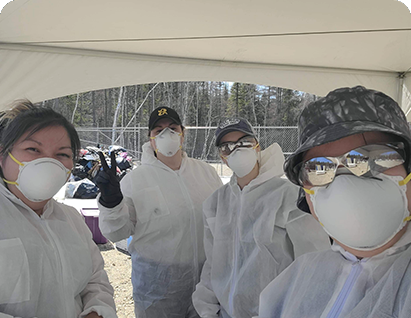
In the face of extreme weather events and wildfires, being prepared to respond is crucial. The Conseil des Anicinapek de Kitcisakik wants to take a proactive approach by integrating climate risks directly into its emergency measures plan.
By forming a fire brigade, analyzing territorial vulnerabilities, and developing an intervention plan tailored to their reality, the community aims to strengthen its capacity to respond quickly and effectively. A collective effort that provides lasting structure to emergency responses and places climate resilience at the heart of the Nation’s planning. The project will also ensure the sustainability of the emergency measures committee, an essential foundation for meeting the climate challenges ahead.
Support for First Nations Climate Leadership
The projects presented here were funded through the First Nations Climate Leadership Support Initiative, offered as part of the Government of Quebec’s 2030 2030 Plan for a Green Economy.