Characterizing marine and coastal Nitassinan of Ekuanitshit and Pakua Shipu

Project carried out in collaboration with Pêcheries Shipek and the Ekuanitshit and Pakua Shipu First Nations.
Since 2022, Pêcheries Shipek and the First Nations of Ekuanitshit and Pakua Shipu have been working with our team to develop a profile of the marine and coastal environments of their Nitassinan. The project focuses on the conservation and sustainable management of the marine territory and its resources. Together, we identified and documented species of commercial, food, cultural, social, and ecological importance to the communities while assessing the quality of their habitats.
This work created valuable opportunities for dialogue and knowledge sharing among partners and across generations. It also strengthened community members’ connection to the marine environment through the exchange of knowledge, particularly with land guardians.

A Collaborative Approach Rooted in the Territory
From the beginning, we worked closely with Pêcheries Shipek team to establish marine conservation priorities for the First Nations of Ekuanitshit and Pakua Shipu.
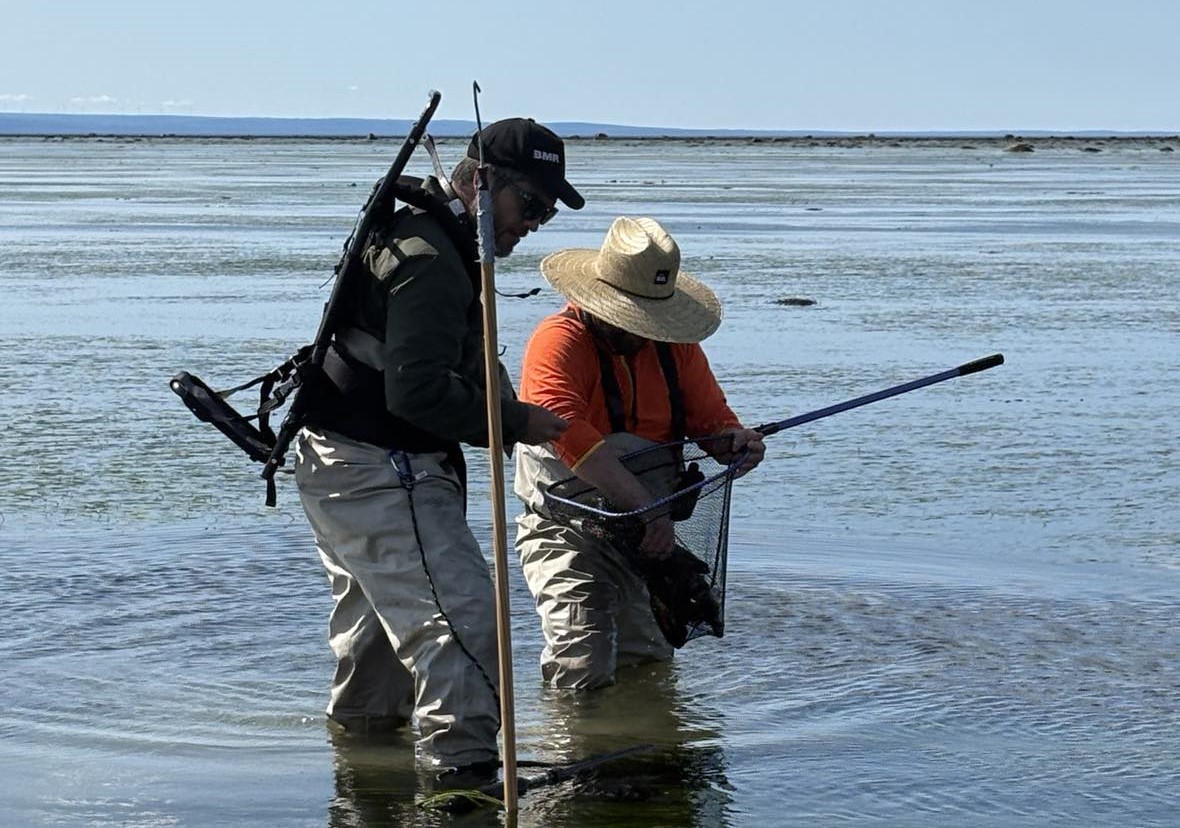
In 2023, as part of efforts to strengthen shellfish aquaculture capacity, Pêcheries Shipek employees travelled to the United States to visit three hatcheries. During these visits, biologists provided tours of the facilities and shared their expertise on cultivation methods for sea scallops (Placopecten magellanicus), green sea urchins (Strongylocentrotus droebachiensis), and Atlantic razor clams (Ensis directus). Later that summer, we also conducted a field excursion at sea with community fishers and other Pêcheries Shipek staff to explore priority areas for scallop fishery revitalization.


In 2024, we carried out habitat characterization work in one of the restoration areas using a remotely operated vehicle (ROV). We also organized a second marine field trip in the Mingan Islands area with land guardians to identify bird species found within Ekuanitshit’s marine Nitassinan. This activity allowed participants to develop practical skills and build on the knowledge gained during a seabird monitoring training session offered in spring 2024.
Following this initiative, we developed a guide to common bird species of the St. Lawrence River in both French and Innu, designed to support land guardians in identifying local bird species. During the same period, we accompanied the First Nation of Ekuanitshit during a shoreline cleanup activity led by Pêcheries Shipek. In total, more than 180 pounds of waste were collected.
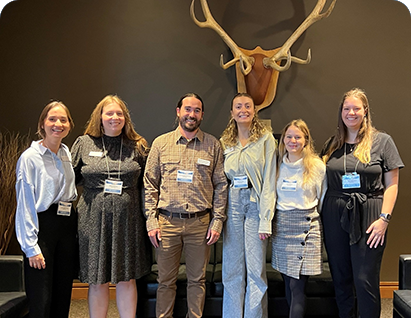
In 2025, we returned to the restoration site, this time using a drop-camera system to obtain higher-quality imagery of the seafloor for habitat characterization purposes. We also participated in training on shellfish area monitoring delivered by Yves Lamontagne, Regional Coordinator of the Canadian Shellfish Sanitation Program at Environment and Climate Change Canada.
Through this shellfish water quality training, participants strengthened their technical skills in water sampling. The initiative enabled them to deepen their understanding of coastal ecosystems, assess the potential of shellfish resources, and implement sustainable practices tailored to their territory. By acquiring this specialized expertise, the community is increasing its autonomy in the development of marine-related projects while enhancing its capacity to make informed decisions that support responsible development.

Strengthening and Passing On Connections
The activities carried out throughout this project fostered the transmission of knowledge related to the marine environment and helped reconnect participants with the lands, waters, and resources that have sustained their communities for millennia.
The project also contributed to the development of technical knowledge regarding the conservation tools best suited to the marine and coastal territories of Ekuanitshit and Pakua Shipu. Beyond the skills and knowledge gained, the initiative strengthened connections among people, knowledge systems, and the territory itself.

Key Partners
The marine conservation and sustainable resource management project carried out by the Innu communities of Ekuanitshit and Pakua Shipu, in collaboration with the First Nations of Quebec and Labrador Sustainable Development Institute (FNQLSDI), was made possible through funding provided under Fisheries and Oceans Canada’s Oceans Management Program.
This funding envelope was dedicated to First Nations communities located along the St. Lawrence Estuary and the Northern Gulf of St. Lawrence from 2021 to 2026. Its objective was to increase First Nations participation in the governance and conservation of marine spaces.
Tshinashkumitinan — Thank You
Thank you to everyone who participated in the project activities. Your commitment, ideas, and the time you generously dedicated to this initiative were invaluable. Thanks to your contributions, this profile faithfully reflects the richness of the discussions and the quality of the work accomplished collectively.